



Most enterprise data is unstructured. Most ETL pipelines ignore it. Here is what closing that gap looks like.
When most teams discuss ETL, they typically envision relational data. Tables, schemas, foreign keys. A source system, a transformation step, a clean destination. It is a well-understood problem with well-understood solutions.
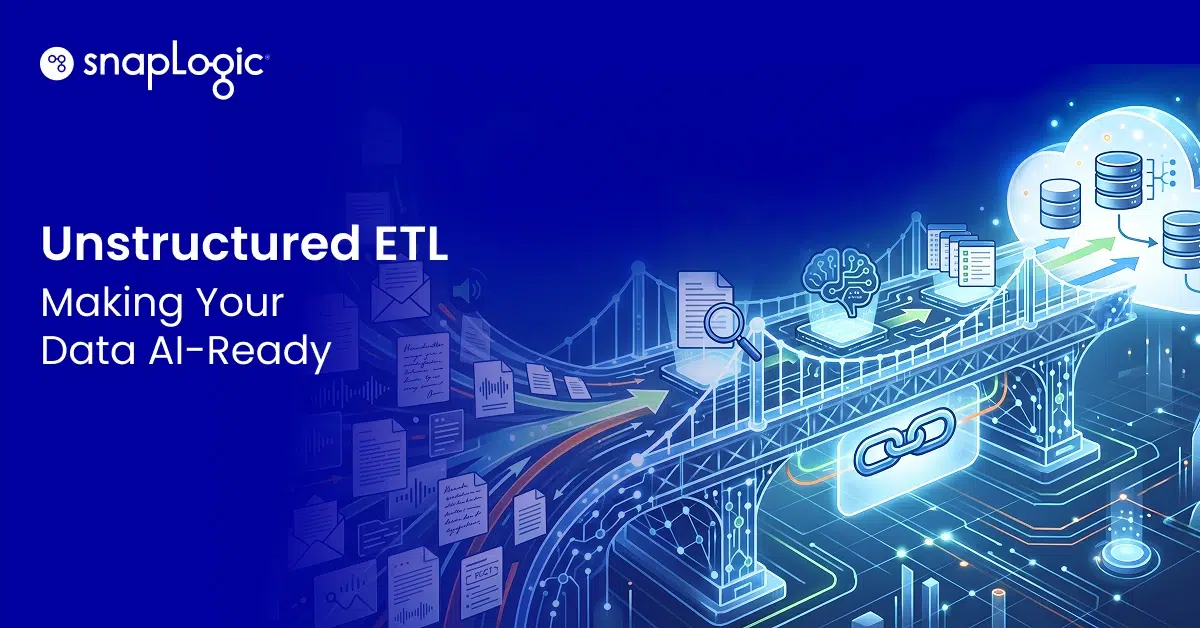
Unstructured data is a different problem. PDFs, contracts, email threads, support tickets, audio transcripts, images, HTML pages, free-form logs. This content makes up a significant proportion of the data that most enterprises actually hold, and yet classic ETL tooling doesn’t even attempt to address it.
That gap in visibility is becoming a liability. The AI use cases organizations are investing in today need access to the unstructured data sources on which the business actually runs. For example, perhaps the:
- Contract intelligence workflow needs to read PDFs
- Customer service AI needs to process tickets and call recordings
- Compliance monitoring system needs to parse policy documents and flag deviations
If your integration layer cannot handle these inputs, the AI layer (which relies on it) cannot do its job effectively.
Did you know? It’s estimated that 80-90% of enterprise data is unstructured.
What unstructured ETL actually involves
Structured ETL is a pipeline problem. Unstructured ETL is something different: a comprehension problem with a pipeline underneath it.
The extraction step alone is non-trivial. A PDF might be a scanned image, a native document, or a mix of both. A contract might have tables, handwritten annotations, and attachments. An email thread might reference a document that lives in a separate system. Before any transformation can happen, the raw content needs to be parsed, OCR-processed where necessary, and segmented into meaningful units.
Then comes structure inference. What is this document about? What entities does it reference? What are the key fields that downstream systems care about? For structured data, the schema answers these questions. For unstructured data, the extraction layer has to infer the answers, typically using a combination of rules, named entity recognition, and increasingly, large language models.
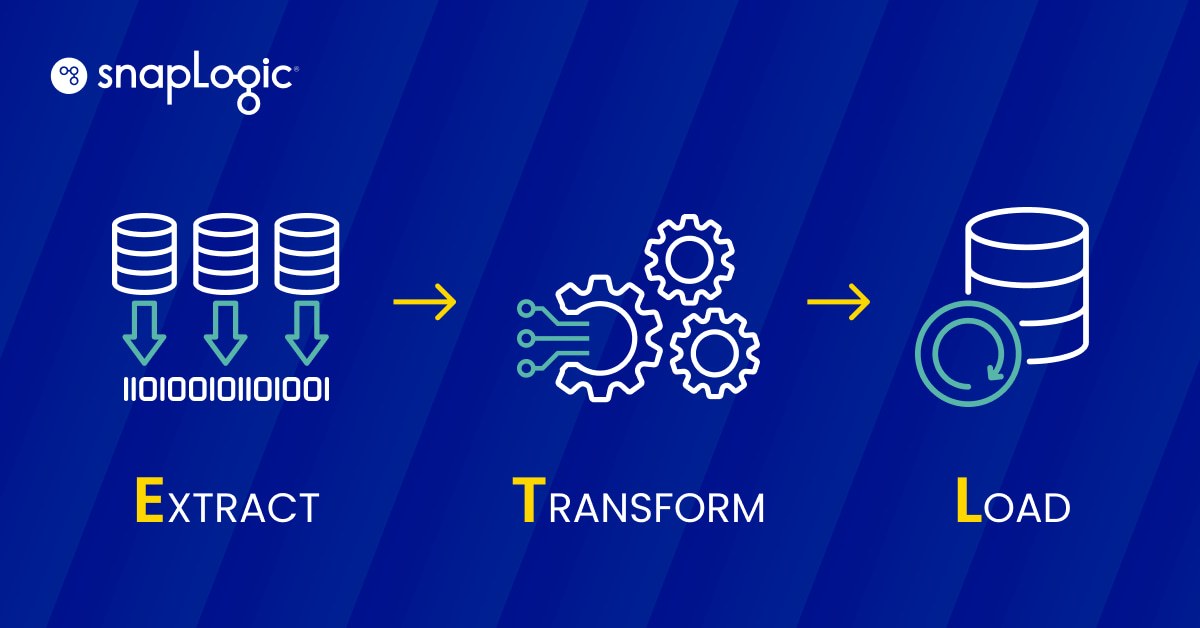
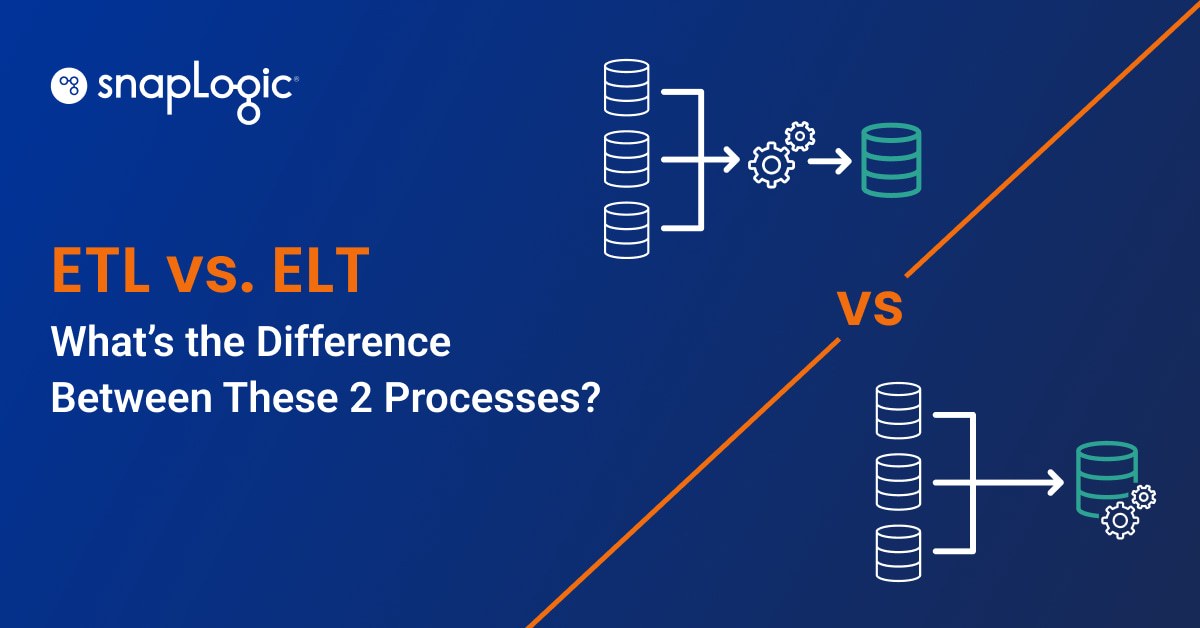
Finally, the output needs to land somewhere useful. A vector store for semantic search. A relational database for reporting. A downstream application that expects a specific payload shape. The transformation and load steps are familiar, but the usability of the results depends entirely on the quality of what came out of the comprehension layer.
Unstructured ETL is not a bolt-on feature. It is a foundational capability that determines which AI workflows your organization can run and which ones remain theoretical.
Where enterprises are running into trouble: failure modes
Defining a strategy for unstructured ETL is only half the battle. Scaling it to production is where most enterprises stumble. Here are the most common failure modes that undermine AI data pipelines.
Point-solution sprawl
The most common failure mode is point-solution sprawl. A team builds a Python script to extract data from PDFs. Another team uses a different tool for email processing. A third team handles document ingestion manually. None of these processes shares monitoring, error handling, lineage tracking, or governance controls. The result is a collection of brittle, invisible pipelines that break quietly and are impossible to audit. When a downstream AI model produces a bad output, tracing it back to a data quality issue in an undocumented extraction script is a project in itself.
Underestimating volume
The second failure mode is underestimating the volume problem. Unstructured data does not arrive in batches at predictable intervals. It accumulates continuously. Support tickets come in around the clock. Contracts close on deal timelines, not integration team schedules. A processing architecture that works fine at 1,000 documents a day may not hold up at 100,000.
Neglecting permissions
The third failure mode is neglecting the importance of permissions and ACLs. All of those documents have permissions set on them where they reside, whether that is in a file store or attached to some other object (a ticket, an email, or a record in a CRM). Those permissions need to be respected and carried with the information that is read out of the document, to avoid the ingestion becoming a source of leaks of data that is supposed to be restricted or that may be subject to regulation.
Setting it and forgetting it
The final failure mode is treating unstructured ETL as a one-time exercise. Document formats change. Email systems get replaced. New data sources appear. A durable capability requires pipelines that are robust against these changes, and which can be updated, tested, and versioned. One-off extraction scripts won’t cut it long-term.
What a production-ready approach looks like
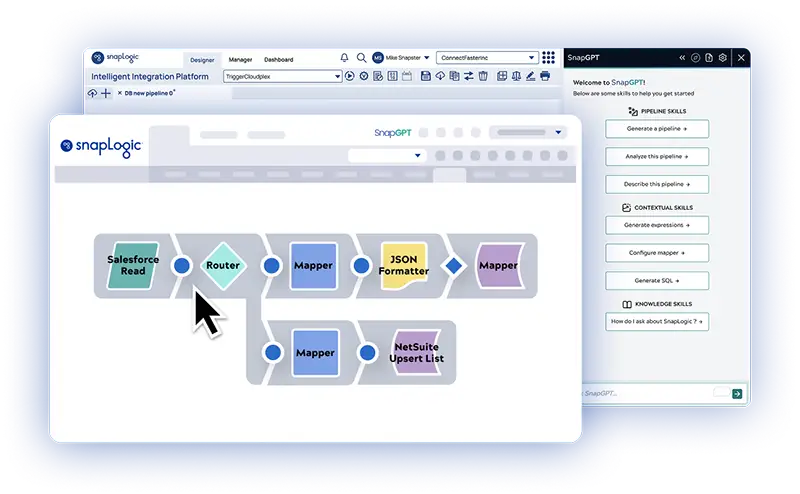
The starting point is treating unstructured extraction as a first-class pipeline type, not an exception to be handled outside the main integration platform. That means the same visual authoring, monitoring, alerting, retry logic, and lineage tracking that applies to structured pipelines applies here too.
SnapLogic handles this requirement through a combination of native document processing Snaps, LLM-connected extraction pipelines, and a metadata framework that carries provenance information from source to destination. A pipeline that ingests contracts can extract key dates, parties, obligations, and penalty clauses, validate the output against a schema, and route the result to the correct downstream system, all within the same orchestration layer used for database replication and API integration.
The practical benefit is operational consistency. The team that monitors your Salesforce sync pipeline uses the same dashboard to monitor your contract ingestion pipeline. Anomalies surface in one place. Lineage queries work across structured and unstructured sources. Compliance teams can audit data flows without needing to understand which bespoke scripts run where.
The role of LLMs in the extraction layer
Large language models have changed what is possible in unstructured extraction. Tasks that previously required extensive rule engineering, such as extracting clauses from non-standard contract formats or classifying the intent of free-form support messages, can now be handled by a well-prompted model call within the pipeline.
The key is treating LLM calls as pipeline components with the same operational discipline as any other step. That means defining input schemas, validating outputs, handling failures gracefully, and caching where appropriate to manage cost. An LLM extraction step that runs without validation or retry logic is a liability. One that is properly instrumented is a durable capability that core business processes can rely on.
SnapLogic’s AI integration layer makes LLM calls first-class pipeline citizens. Models from major providers connect through Snaps with configurable retry, output parsing, and downstream routing. Teams can build extraction pipelines that call an LLM for comprehension and then route the structured output to any destination, without custom orchestration code.
OEM and embedded integration: an opportunity for ISVs and platform builders
Unstructured ETL is an equally useful capability for both enterprise IT and software vendors, who can embed it directly into their own products. Consider the verticals where document-heavy workflows are standard. For example, legal technology, insurance, healthcare, financial services, procurement platforms, and contract lifecycle management.
In each of these markets, customers are asking vendors not just to store documents but to do something intelligent with them. Extract the key terms. Flag the anomalies. Populate the fields automatically. Surface the relevant clause.
Vendors who can answer that question with a native capability, not a request to connect to a third-party tool, have a meaningful product advantage. And the fastest path to that capability is embedding a proven integration and extraction layer rather than building one from scratch.
What embedded SnapLogic enables for OEM partners:
- Ship document intelligence as a native product feature, branded to your platform
- Connect your product to customer data sources without the need to build and maintain custom connectors
- Offer pre-built extraction templates for the document types that are used by your customers
- Deliver governed, auditable pipelines that meet enterprise compliance requirements out of the box
- Reduce time-to-market for AI features from quarters to weeks
SnapLogic’s OEM program allows software vendors to embed the full integration and ETL capability, including unstructured processing, directly into their own platforms. The experience is white-labeled and deployed within the vendor’s own infrastructure. Customers interact with a native feature, not a separate integration tool. The vendor controls the surface, while SnapLogic provides the depth.
For product teams evaluating how to add document intelligence to their platform, the build-versus-embed question usually comes down to maintenance cost over time. Building a custom extraction stack means signing up to be responsible for the OCR layer, the LLM orchestration, the connector ecosystem, the monitoring infrastructure, and the compliance controls.
Embedding SnapLogic means shipping those capabilities on day one and spending engineering cycles on what differentiates the product, rather than the plumbing underneath it.
From theory to pipeline: getting started
The practical starting point for most teams is identifying two or three high-volume document types that currently require manual handling or brittle and disconnected scripts. Contracts, invoices, and support tickets are common entry points. Building a governed, monitored extraction pipeline for those sources creates a reusable pattern that extends to the next use case without starting from scratch.
For product teams, the question is which AI features in your roadmap depend on document or unstructured data access, and whether you want to build or embed the capability to support them.
Either way, the underlying principle is the same. AI workflows are only as capable as the data access layer beneath them. Getting that layer right, including both structured and unstructured sources, is the work that makes everything else possible.
Ready to see it in action? Take a self-guided product tour or book a demo to meet a SnapLogic integration expert and talk about unstructured ETL for your environment or your product.