

Software and technology companies operate some of the most sprawling technology landscapes in existence: hundreds of SaaS tools, multi-cloud infrastructure, homegrown internal platforms, and product data systems assembled over years of rapid growth and acquisition that were never designed to talk to one another.
The pressure to scale efficiently, ship faster, protect customer data, and deliver AI-powered product experiences has made integration a strategic priority that reaches well beyond the engineering team. Choosing the right integration platform is one of the most consequential technology decisions a software or technology enterprise can make in 2026.
What is iPaaS, and why does it matter for software and technology companies?
An iPaaS, or Integration Platform as a Service, is a cloud-based platform for connecting applications, data sources, and business processes across hybrid and multi-cloud environments. Rather than building custom integrations one at a time, teams design, deploy, and manage pipelines through a centralized, reusable platform.
In software and technology companies, the integration challenge is deceptively complex. A SaaS business might need to connect its CRM, product analytics platform, billing system, customer success tooling, and data warehouse. And do it in real time so that sales, finance, and engineering are all working from the same version of the truth.
Without a robust iPaaS, these connections depend on custom scripts, brittle point-to-point APIs, and scheduled batch jobs that create data lag, reliability risk, and mounting technical debt.
The “as a service” model matters because it turns integration from an engineering backlog item into a scalable, governed capability. Teams can provision new pipelines as the product and business evolve, without rebuilding from scratch each time, while maintaining consistent security, observability, and access controls across the entire data estate.
In 2026, leading technology companies are also moving beyond connectivity toward intelligent, event-driven workflows: systems that can detect a usage signal, trigger a churn risk alert, update a customer record in the CRM, and route an action to the right team in a single automated sequence.
What is the best iPaaS for software and tech?
The best iPaaS for software and technology organizations depends on the scale, architectural complexity, and velocity of your environment. For companies managing large SaaS stacks, multi-cloud deployments, and high-volume product data pipelines, the platform needs to do more than move data.
It needs to support real-time event processing, enforce security and data governance, connect both commercial SaaS tools and internal systems, and increasingly power AI-driven automation at the integration layer.
Key criteria for tech iPaaS selection in 2026 include:
- AI-native design (not bolted on)
- Data governance and security controls that are built into the platform
- Broad connector coverage for the modern SaaS stack
- Support for agentic workflows where pipelines can reason and act with minimal engineering intervention
The right platform handles the full technology integration spectrum. From product telemetry to revenue operations, DevOps automation, customer onboarding, and unified data across engineering, finance, and go-to-market systems.
For enterprises, the evaluation should weigh speed-to-value, total cost of ownership, and the ability to serve teams beyond a dedicated integration engineering function. Platforms that require specialist developer resources for every new pipeline create bottlenecks that slow delivery and concentrate fragility in a small number of key people.
How does iPaaS support security and data governance for technology companies?
For software and technology organizations, data governance is not a compliance afterthought. It is a customer trust and business continuity requirement.
Frameworks including GDPR, CCPA, SOC 2, ISO 27001, and emerging AI governance mandates impose strict requirements on how customer and product data is collected, processed, transformed, and audited. Because the iPaaS is the system through which that data actually flows, it sits at the center of any serious governance architecture.
A mature platform supports this through:
- Full audit logging of every pipeline execution and data classification
- Field-level controls (masking, encryption, access restrictions) applied without custom code
- Centralized pipeline documentation that satisfies both internal governance requirements and external audit processes.
API security is a particularly strong iPaaS use case for technology companies. SaaS platforms must expose compliant APIs to customers, partners, and internal consumers while enforcing authentication, rate limits, and usage monitoring.
Built-in API management handles OAuth 2.0 and token-based authentication and monitors consumption in real-time, turning a recurring engineering concern into a governed, scalable capability that the business can rely on.
What is agentic integration, and how does it apply to software and tech organizations?
Agentic integration moves iPaaS beyond passive data movement to active, intelligent orchestration. Rather than simply transferring data from A to B, agentic pipelines observe events, reason about context, make decisions, and take action within governed boundaries.
In software and technology companies, the applications are immediate. A product-led growth workflow can monitor usage signals, query a scoring model, check account health data, and route a high-intent trial user to the right sales sequence in milliseconds with every decision logged and observable.
In SaaS operations, a customer churn signal can trigger a pipeline that pulls subscription data, checks support history, evaluates product engagement patterns, routes the account to the right success team based on tier and risk score, and notifies the account owner before the renewal window closes.
For technology organizations evaluating iPaaS platforms in 2026, agentic capability should be a first-class criterion. Platforms where AI is native to the architecture rather than layered onto a legacy foundation will support more sophisticated workflows and perform more reliably in production environments where engineering teams expect observability, reliability, and speed.
How does SnapLogic compare to other iPaaS solutions for software and technology companies?
When evaluating an iPaaS, software and technology organizations typically shortlist several platforms based on analyst coverage, existing vendor relationships, and peer references. Each platform has genuine strengths and meaningful trade-offs, and the right choice depends heavily on an organization’s existing architecture, team composition, and integration ambitions.
The table below reflects the key dimensions that matter most to tech/software industry leaders in 2026.
| Platform | Strengths for Tech/Software | Considerations | Best for |
|---|---|---|---|
| SnapLogic | AI-native platform with agentic pipelines, intelligent mapping, and LLM orchestration as first-class features. 1,000+ pre-built Snaps covering the modern SaaS stack (Salesforce, Workday, ServiceNow, Snowflake, Databricks, GitHub, Jira, AWS, Azure, GCP) and internal data platforms. Accessible to data engineers, RevOps teams, and developers alike. MCP Server enables pipelines to be called directly as AI agent tools. | Consumption-based pricing should be validated against projected workload volume to confirm cost advantage at scale. | Technology teams that want a low-code, AI-native platform with broad SaaS coverage and the ability to support adoption across engineering, data, and business teams. Low-code friendly. |
| MuleSoft (Salesforce) | Copilot integration in Logic Apps and strong support for Azure-native AI workloads. Good coverage for Microsoft-centric environments, including Dynamics 365, Teams, Azure SQL, and Power Platform. | Code-first, pre-LLM architecture; AI features are layered on rather than native. Steep learning curve requiring Mule-certified developers. High vCore licensing costs create significant expense at volume; specialist talent is scarce and costly. | Large enterprises with existing MuleSoft investments and dedicated integration teams. Developer-heavy. |
| Microsoft Azure Integration Services | Copilot integration in Logic Apps; strong for Azure-native AI workloads. Good coverage via Azure and custom connectors, especially in Microsoft-centric environments (Dynamics 365, Teams, Azure SQL). | A suite of separate services (Logic Apps, Service Bus, API Management, Event Grid) rather than a unified platform; less cohesive for cross-cloud agentic scenarios. Full suite requires Azure expertise. Costs can rise unpredictably across service tiers at enterprise scale. | Organizations deeply committed to the Microsoft/Azure ecosystem. Azure-native. |
| Boomi | Cloud-native low-code platform with an accessible designer suited to rapid deployment. Boomi GPT for pipeline generation. Generally lower cost than MuleSoft. | Agentic capability is early stage. Connector depth for specialized data engineering and analytics systems is narrower than SnapLogic’s, and custom connector work may be needed for some use cases. | Mid-market technology organizations with less complex integration needs and cost sensitivity. Mid-market. |
| Workato | Recipe-based platform designed for business users and operations teams with minimal coding required. AI Copilot for recipe building. Strong for business process automation. | Less proven for high-volume, high-criticality data engineering pipelines. Shallower coverage for complex multi-cloud and analytics infrastructure integration. | Business and operations-led automation at the departmental level; not suited to core infrastructure integration. Business-user-led. |
For technology organizations with complex multi-cloud and SaaS-heavy environments, the key platforms to evaluate are SnapLogic, MuleSoft, and Microsoft Azure Integration Services. All three handle enterprise-grade integration but differ meaningfully in developer dependency, AI-readiness, and total cost of ownership.
SnapLogic stands out on 3 fronts:
- A low and no-code platform that broadens who can build and maintain integrations beyond a specialist engineering function
- AI and agentic capabilities are built into the architecture from the ground up
- TCO that holds at the data volumes and pipeline counts typical of enterprise technology organizations
Technology companies looking to eliminate engineering bottlenecks, accelerate time to insight, and put AI to work at the integration layer now will find that SnapLogic is the strongest fit among the platforms evaluated.
Can SnapLogic connect CRM, product analytics, and data warehouses?
Yes. A common pattern might be connecting Salesforce to a product analytics platform like Amplitude or Mixpanel and a data warehouse like Snowflake, so that revenue, product usage, and customer health data stays synchronized across go-to-market, engineering, and data teams without manual reconciliation.
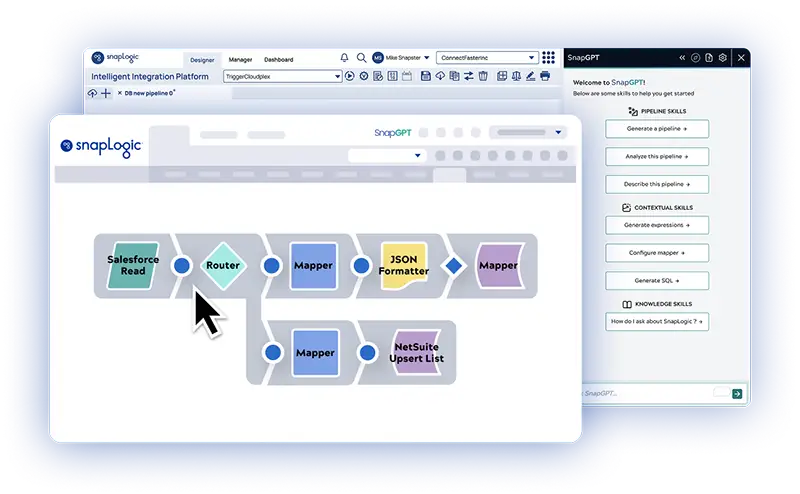
SnapLogic handles this through purpose-built Snaps that account for each platform’s data models and API semantics rather than relying on generic REST connectors.
The same approach applies in DevOps and engineering operations, where a typical implementation connects GitHub, Jira, and PagerDuty to internal reporting systems, security tooling, and incident management workflows within a single governed environment.
Which technology systems does SnapLogic integrate with?
SnapLogic’s 1,000-plus pre-built Snaps span the full enterprise tech stack.
- CRM and revenue operations: Salesforce, HubSpot, Marketo, Outreach, Gong, and ZoomInfo, with real-time synchronization across sales, marketing, and customer success workflows.
- Product and engineering: GitHub, GitLab, Jira, Confluence, PagerDuty, Datadog, and Splunk, connected to internal dashboards, incident response systems, and security tooling.
- Data and analytics: Snowflake, Databricks, Google BigQuery, Azure Synapse, dbt, and Fivetran, enabling real-time product analytics, revenue intelligence, and AI model pipelines without custom data engineering for each new use case.
- Cloud infrastructure: AWS (S3, Lambda, Redshift, Glue), Microsoft Azure, and Google Cloud Platform, with event-driven pipeline triggers across all three major clouds.
- Business systems: Workday, ServiceNow, NetSuite, and Coupa for HR, IT operations, finance, and procurement workflows.
Most integration projects at software and technology companies can start from a pre-built foundation. Every new pipeline benefits from connectors and governance configurations already in place.
Ready to modernize your integration stack?
SnapLogic helps software and technology organizations connect their most critical systems faster, with less risk, and at lower cost than legacy middleware platforms.
Whether you are unifying product and revenue data across a fragmented SaaS stack, building real-time data pipelines into your analytics infrastructure, automating DevOps and incident response workflows, or embedding agentic AI into your integration architecture, SnapLogic’s platform gives your team the speed and governance to deliver.
See how leading technology companies are turning integration complexity into a competitive advantage. Explore the platform with a self-guided tour, or talk to our team about what is possible for your organization.